



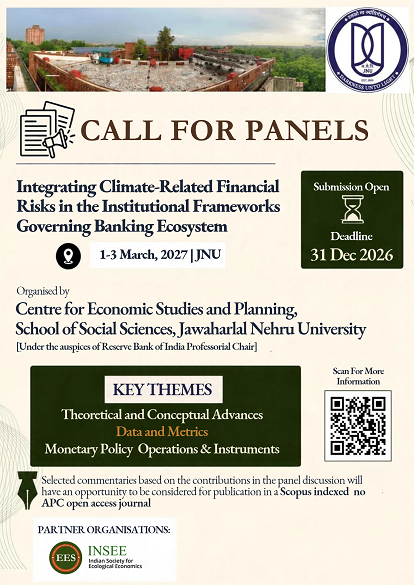

CALL FOR PAPERS
International Conference
Integrating Climate-Related Financial Risks in the Institutional Frameworks Governing Banking Ecosystem
1-3 March, 2027
Organised by
Centre for Economic Studies and Planning, Jawaharlal Nehru University
[under the auspices of Reserve Bank of India Professorial Chair]
CONCEPT NOTE
‘Climate-related ‘events’ affect the functioning of ecosystems. But the nature and type of such perturbations cannot always be predicted. They are highly multidimensional, non-linear, and subject to tipping points. It changes the ‘equation’ between expected risk and expected returns from financial assets. In turn, it affects the economic systems with social consequences. The seriousness of climate-related financial risks (CRFR) has been recognized by Basel Committee on Banking Supervision (BCBS) in its 2024 version of ‘Core Principles for Effective Banking Supervision’ as one of the new risks that can affect the stability and resilience of financial systems. Reserve Bank of India (RBI) implements the international Basel capital frameworks.
CRFR refers to the potential risks that may arise from climate change (physical risk) or from efforts to mitigate it (transition risk). Its economic consequences can be microeconomic such as stranded assets, as well as macroeconomic such as rise in prices. Financial consequences cover all the traditional categories such as credit (increase in default due to landslides), market (repricing of assets due to repeated wildfires) and underwriting (increased insurance gap due to unforeseen drought intensity), among others. Each has its own social consequences.
A rise in the ‘spread’ and ‘depth’ of impact of climate-related ‘events’ on ecosystems widens and amplifies the consequent financial, economic and social ramifications. The costs are borne by the State, or the insurance companies or the individuals/ households, in monetary and/or non-monetary terms. It can have fiscal implications (additional public expenditure to minimize loss of life during cyclones), affect financial viability of insurance companies (claims by much larger number of farmers affected by drought than expected), and impact households (higher out-of-pocket expenditure to take care of health damages due to landslides). In most cases, the marginalized bear a disproportionate share of the social costs.
One of the statutory mandates of RBI is to ensure monetary stability. It follows that the part of the financial ecosystem under its jurisdiction is to be managed with an objective to minimize the impacts of climate-related ‘events’ on it. Draft Disclosure framework on Climate-related Financial Risks, 2024 released by RBI is a step towards this direction.
Against four pillars – Governance, Strategy, Risk Management, and Metrics and Targets – it proposed a variety of disclosures to be made by the entities regulated by it, including some Co-operative Banks and NBFCs. It is similar in approach to the Environmental, Social, and Governance (ESG) framework of the Securities and Exchange Board of India (SEBI). However the scope the RBI framework is much wider. The financially included population stands at about 90%.
RBI’s Draft Disclosure Framework (2024) reflects the developments at the BCBS, the Network of Central Banks and Supervisors for Greening the Financial System (NGFS) and International Sustainability Standards Board (ISSB) vis-a-vis International Financial Reporting Standards (IFRS). There are several Central Banks, including RBI, are making attempts to address the impacts on the financial systems originating from climate-related ‘events’. Notwithstanding such efforts, several questions are yet to be answered. The conference is expected to address some of them.
For example, as CRFR are to be addressed both at the individual and systemic level, date is required across scales. Risk assessment requires combination of several databases, to overcome temporal or spatial gaps within each data source. It can range from agricultural geospatial analysis to the location, characterization and valuation of infrastructure and assets. Data quality and accessibility remains a significant challenge notwithstanding the advances such as Reserve Bank – Climate Risk Information System (RB-CRIS). More granular data is needed against multiple variables.
This conference offers a forum to researchers, policymakers and practitioners to engage with this economically sensitive and socially relevant aspect of public policy.
INDICATIVE LIST OF TOPICS AND QUESTIONS:
-
Theoretical and conceptual advances:
-
How does the climate-related physical risks and transition risks (say, policies towards achieving ‘net zero’) impact the trade-offs between stabilising inflation and output and how can it be assessed?
-
How does the CRFR impact monetary policy transmission and structural variables such as the natural rate of interest?
-
How far the ‘Green Deposits’ can help the banks to dampen the impact of CRFR on its assets and liabilities? What will be contours of a conceptual framework for a globally harmonised climate finance taxonomy defining such deposits?
-
What kind of adjustments is needed in the traditional macroeconomic models to consider different climate considerations such as temporary and permanent effects as well as supply-side and demand-side shocks?
-
As modelling climate change requires addressing several dimensions of uncertainty that differ between physical and transition impacts, which type of integrated assessment models is best suitable to capture both types of impacts?
-
-
Data and metrics:
-
Are standardised datasets capturing various variables are interoperable enough and adequately granular for assessment of CRFR?
-
How far the existing data handling software can capture and analyse multidimensional data on physical and transition risks to yield results that can be used in evidence based policy making
-
What are the attributes of metrics and indices to capture CRFR and communicate the same to policymakers and practitioners?
-
-
Adjustments in the traditional monetary policy operations and instruments:
-
Which options are best suited for adjusting operational frameworks to CRFR, within the purview of credit operations, collateral policies, and asset purchases? How can ‘best’ be defined? What evidence is required to justify the claim?
-
While traditionally the central banks adjust their operational frameworks from a risk management perspective, do they need to move beyond it? For example, instead of ensuring not undermining the transition to a low-carbon economy can it explore ways in which they can actively support that transition?
-
We welcome submissions that address issues aligned with the theme of the conference.
SUBMISSION GUIDELINES:
-
Extended abstracts (1500-2000 words) to be sent to chair_rbi[at]jnu[dot]ac[dot]in.
-
It is mandatory to include a title, about five keywords and email address of every author. Indicate the corresponding author for multi-authored papers.
-
Itshould clearly indicate the research problem, research question(s), method(s) of analysis, data sources, key results and the way forward.
-
Format: A4, 1.5 spacing, Garamond, 1 inch margin all sides, Chicago style of citation (author-date).
-
All submissions will be subjected to similarity check in every stage including AI generated content. Use of AI must be clearly mentioned. Submissions in violation of relevant ethical guidelines will not be processed.
-
-
Selected papers will have an opportunity to be considered for publication Ecology, Economy and Society–the INSEE Journal. EES is Scopus-indexed, diamond open access with no APC and COPE member.
IMPORTANT DATES:
Submission opens on September 01, 2026.
Deadline for submission of extended abstracts is October 15, 2026
Decision on selection of extended abstracts will be communicated: November 30, 2026.
Deadline for submission of full paper (4000-6000 words) is December 31, 2026.
Decision on selection of full paper for presentation at the conference will be communicated within a month from submission. End date: January 31, 2027.
Deadline for communication of willingness to presentation in the conference is February 03, 2027.
Deadline for submission of final paper (6000-8000 words) for consideration of publication (6000-8000 words) is April 30, 2027.
GENERAL INFORMATION:
-
Travel support within India as per the Government of India rules will be extended to one presenter for every paper. There is no registration fee.
-
Local hospitality will be provided to all authors of papers to be presented at the conference.
ABOUT
Jawaharlal Nehru University (JNU): JNU, established in 1969, is a premier central university known for academic excellence, critical inquiry, interdisciplinary research, and inclusive learning. JNU fosters innovative thinking, social responsibility, and a vibrant research culture across humanities, social sciences, natural sciences, and professional studies. JNU has consistently ranked among the top universities in the country.
Centre for Economic Studies and Planning (Centre): Centre celebrated its Golden Jubilee in 2023. Over the years, it has established and retained its status and reputation as a premier institution for teaching and research in Economics. The Centre offers M.A. and Ph.D. programmes in Economics. Specialisation of its faculty encompasses various branches of Economics. The richness of the teaching and research programme is reflected in the structure of the courses and the research output of both faculty and students.
RBI Professorial Chair: RBI established RBI Professorial Chair in JNU in 1997 under its Scheme of Corpus Fund for promotion of economic research, training in banking, real sector issue, monetary and financial economics. It is hosted by the Centre. It was held in the past by Kunal Sengupta, Anjan Mukherji, Satish K Jain, and C P Chandrasekhar. Nandan Nawn holds this position since July 2025. He is the conference convenor.
PARTNER ORGANISATIONS:
|
Ecology, Economy and Society–the INSEE Journal. The journal aims to offer authors a forum to address socio-environmental issues from, across and within the natural and social sciences. The journal welcomes contributions at the ecology-economy-society interface that contribute to informed debates. The journal promotes methodological pluralism and inter-disciplinary research. Presently it is in its ninth year. It is a Q2 journal (Scimago). |
Indian Society for Ecological Economics (INSEE) It was established in New Delhi, India on September 24, 1998 and was registered under the Societies Act in January 1999. It is a regional society affiliated to the International Society for Ecological Economics. INSEE aims to further the cause of sustainable development by providing a forum for continuous dialogue among scholars, practitioners and policy analysts working at the interface of the economy, society and the ecosystem. |